
Bhakra Canal Bridge Collapse: NHAI and PWD Shift Blame as Accountability Remains Unclear
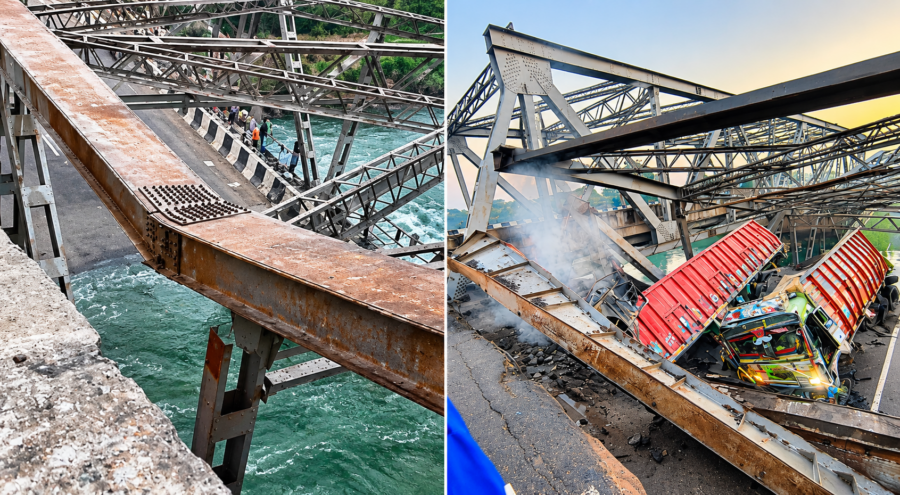
The collapse of a 60-metre-long steel bridge over the Bhakra Canal near Pasiana in Patiala has raised serious questions about infrastructure safety, departmental accountability and the monitoring of public infrastructure in Punjab. Even three days after the incident, authorities have not provided a clear answer about the bridge’s actual load-bearing capacity or the circumstances that led to its collapse.
What has made the situation more concerning is the apparent lack of clarity over which department was responsible for the bridge. Instead of providing definite answers, officials from the National Highways Authority of India (NHAI) and the Punjab Public Works Department (PWD) have presented different explanations regarding their respective responsibilities.
The incident has exposed important gaps in coordination and raised questions about how a bridge carrying heavy vehicles could have an unclear load-capacity record.
NHAI and PWD Point Fingers Over Responsibility
The responsibility for the collapsed bridge has become a subject of disagreement between government departments.
NHAI officials have stated that the bridge was originally constructed by the Border Roads Organisation (BRO) under the supervision of Punjab PWD officials.
The PWD, however, maintains that responsibility for the bridge’s maintenance was subsequently transferred to NHAI.
This disagreement has left an important question unanswered: which department was responsible for ensuring the bridge remained structurally safe for the traffic using it?
For commuters and residents, the distinction between departments matters less than the need for clear accountability. A public infrastructure project must have defined responsibilities for construction, inspection, maintenance and safety.
When a major bridge collapses, establishing these responsibilities becomes essential to determining whether any negligence or failure occurred.
Why Was the Bridge’s Load Capacity Unknown?
One of the most troubling aspects of the incident is the absence of clear information about the bridge’s load-bearing capacity.
The bridge was approximately 60 metres long and formed part of the Patiala-Sangrur bypass near Pasiana. However, even after its collapse, officials had not provided a definitive figure explaining the maximum weight it was designed to carry.
This raises several important questions. Was the bridge designed to support the weight of heavy commercial vehicles? Were the trucks travelling across it within the permissible load limits? Was the structure inspected regularly to determine whether it could safely handle the traffic passing over it?
Without technical findings and construction records, it would be premature to assign a cause to the collapse.
However, the absence of readily available information about a bridge’s load capacity itself raises concerns about infrastructure documentation and safety oversight.
NHAI Investigation Yet to Establish the Cause
A five-member NHAI team from Delhi has been examining the site to investigate the incident.
The team had reportedly spent two days inspecting the location, but officials had not announced the bridge’s load capacity or identified the possible reason for its failure.
Officials have maintained that the investigation is continuing.
NHAI site manager Abhishek Chauhan also said he did not have information about the bridge’s load-bearing capacity. He stated that the immediate priority was to remove the damaged structure and restore traffic movement.
However, this response raises another important concern: why is information about the structural capacity of a bridge on a national highway not readily available to the officials responsible for managing the site?
The investigation must establish whether the collapse resulted from structural weaknesses, excessive vehicle loads, maintenance deficiencies or other factors.
Two Trucks Removed, Bailey Bridge Planned
Following the collapse, two trucks that had fallen into the canal were emptied and removed from the damaged bridge debris.
Work to dismantle and remove the remaining steel structure has also begun.
Authorities are planning to install a temporary Bailey bridge to restore movement along the affected route. The immediate priority is to provide an alternative crossing and reduce inconvenience to commuters and transport operators.
However, restoring traffic movement is only one part of the required response.
The authorities must also ensure that the cause of the collapse is properly investigated and that the findings are made public.
Accountability Must Go Beyond Clearing the Debris
The Bhakra Canal bridge collapse has raised questions that cannot be addressed simply by removing the damaged structure and constructing a temporary alternative.
The investigation must establish who was responsible for construction supervision, subsequent maintenance, structural inspections and monitoring of vehicle-load restrictions.
If any negligence or procedural failure is established, accountability must be fixed.
Punjab’s roads and bridges serve thousands of commuters, commercial vehicles and businesses every day. Their safety depends on regular inspections, proper maintenance and clear responsibility among the departments involved.
The people using public infrastructure deserve more than assurances that traffic will soon return to normal. They deserve answers about why the bridge collapsed, whether the necessary safety checks were conducted and who was responsible for ensuring its safety.
Until these questions are answered, the Patiala bridge collapse will remain more than an infrastructure failure. It will remain a serious test of transparency and accountability in the management of public infrastructure.